The Trial
“After the death of my Mother,” said she, “my good father had no other desire but to serve God and his neighbour. He worked peacefully at his trade of locksmith, without any idea of ever marrying again; his life was modelled on that of St. Joseph. Every morning he assisted at the holy sacrifice of the Mass, and at the benediction of the most Blessed Sacrament in the evening, when possible; notwithstanding his hard work he always observed the abstinences and fasts of the Church, and regularly approached the sacraments with the most edifying faith and piety. He was often visited with great tribulations which He bore with christian-like fortitude and patience.”
His eldest son, Prosper, had left home and gone to America with Monseigneur de la Hailandière, to whom he was much attached. He settled at Vincennes in the United States, where he resumed his trade of locksmith, attending punctually to his business affairs, and giving there as well as when at home, the edifying example of a virtuous and Christian life.
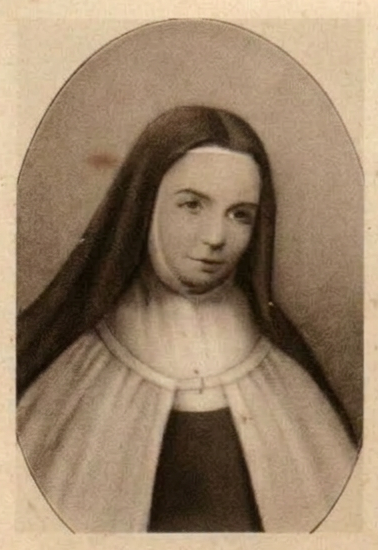
But let us return to Perrine. “My eldest sister,’’ said she, “who attended to the household duties, was attacked with a long illness, and about the same time my father had conceived the idea that I was thinking of leaving him to embrace the religious state. This filled him with alarm and anxiety, for he did not wish to confide his house to the care of a servant. In his perplexity he made me the confident of his troubles hoping thereby to deter me from leaving him. I spoke to him rather ambiguously of my vocation, as I myself did not know when my confessor would permit me to enter the Carmelites, for he still continued his evasive answers and gave me very little hope, notwithstanding my earnest desire to quit the world. In the meantime, my dear father was preparing for the emergency, he spoke of his troubles to the parish priest, his confessor. This worthy pastor, held him in the highest esteem, for he often said that he was the best of his parishioners. Already aware of my intention of becoming a Carmelite, he advised my father to get married. My good parent was naturally of a very cold and retiring disposition, and as can be easily imagined, was not a little embarrassed in the execution of this project; but his kind friend, the priest, assured him that he would undertake to find a suitable companion; and at last, through the intercession of the Blessed Virgin, he was married to a most excellent woman whom we kindly welcomed to our home, and my father was happy.” The sister concludes this artless narrative by enumerating the many other obstacles to be surmounted in the pursuit of her vocation.
“I thought I had at last reached the term of my sufferings and disappointments, and that the doors of Carmel were about to be opened to receive me. One of my aunts with whom I worked, decided to go to Mans to assist at the benediction of the new Carmelite monastery, and at the same time to visit one of the religious, an old friend of hers whom she loved very dearly; she told me that I might accompany her. This good news filled me with joy, and I hastened to my confessor, entreating him to allow me to take advantage of this excellent opportunity to accomplish my long cherished desire. He consented, and gave me a letter for the Reverend Mother Prioress, telling me that I could enter the monastery of Mans if she was willing to receive me. He then gave me his benediction, and I set out immediately with my aunt. We arrived on the eve of the ceremony at the monastery where we were most kindly received by the Carmelites. The next day I assisted at the benediction of a new refectory and a new cemetery. On the same day a postulant received the holy habit.”
“The cloister being thrown open for the occasion, we visited the interior of the convent. I entered the community room and there beheld those dear sisters, many of whom were from my own native province; nothing could have given me more pleasure than this visit. In the afternoon, I had the honour of speaking privately to the very Reverend Mother Prioress to whom I had presented my confessor’s letter the evening previous. I expressed my great desire of becoming a Carmelite. She told me that she had received positive orders from his Lordship the Bishop to admit no more subjects, as the house was then too small, every cell being occupied. Although disheartened by this information, I consulted her respecting my vocation, and spoke to her of my inward dispositions. She evidently saw that, notwithstanding my unworthiness, Our Lord had chosen me to be a child of Carmel, and kindly gave me some information on the rules of the order, expressing her regret at not being able to admit me; nor could she make any application in my behalf, as Monseigneur was at the time absent on a journey. She spoke very highly of the monastery of Orleans from which she had come to found the house at Mans, and promised to apply there for my admission.”
Our disappointed little postulant was thus obliged to return home and resume her ordinary duties. She entreated her confessor to make application for her entrance among the Carmelites of Orleans or those of Blois; however, he did not seem to be very sanguine about the matter…
Excerpt taken from: The Holy Face and the Work of Reparation, by Sr Marie de St Pierre, & Abbè P. Janvier (ed.), (1884), reprinted in 2026 by A.D. Press.

 Work of Reparation
Leave a comment